Overtime Pay Rules: How Overtime Is Taxed in 2026
No — overtime is not taxed at a higher rate. Overtime pay counts as ordinary wages at your normal marginal tax rates, and a bigger check only looks taxed harder because withholding tables annualize one pay period. Since 2025, part of it may even be deductible.
How is overtime pay calculated under federal law?
Under the Fair Labor Standards Act (FLSA), covered non-exempt employees must be paid at least one and a half times their regular rate for every hour worked beyond 40 in a single workweek. The workweek is a fixed, recurring block of seven 24-hour days — it cannot be averaged across two weeks to hide overtime. Your regular rate is not always just your base hourly wage: nondiscretionary bonuses and most shift differentials fold into it, calculated as total weekly straight-time compensation divided by hours worked.
Worked example: you earn $20 an hour and work 45 hours in one week. Your regular rate is $20, so the overtime rate is 1.5 × $20 = $30. The check is 40 × $20 = $800 of straight time plus 5 × $30 = $150 of overtime, for $950 gross that week. At double time the same five hours would pay 5 × $40 = $200 instead.
To see what a $950 week becomes after federal income tax and FICA, run the numbers through the hourly paycheck calculator — it applies the 2026 federal brackets, the standard deduction, and the 7.65% FICA to any wage you type in, so you can compare a regular week against an overtime week side by side.
Which states have overtime rules stricter than the federal floor?
Federal law sets only a weekly trigger: hours past 40 in a workweek. Several states add daily triggers on top. California is the strictest: hours past 8 in a single day are paid at 1.5×, and hours past 12 in a day are paid at double time — the clearest statutory double-time rule in the country. Alaska, Colorado, and Nevada also require daily overtime in common situations, and some states layer on special seventh-consecutive-day rules.
Where a state rule is more generous than the federal floor, the state rule applies. That is why the same 45-hour week can cost an employer differently in Houston than in Los Angeles: in California, hours past 8 on any given day are already overtime even if the weekly total stays under 40. For the state tax side of the picture, the California hourly paycheck calculator adds California's income tax and disability insurance to the federal math.
Two limits worth knowing: no state lets an employer average hours across workweeks, and private-sector 'comp time' — extra time off instead of cash overtime — is generally illegal for hourly workers, no matter what the schedule says.
When does double time apply?
There is no federal double-time requirement at all — the FLSA only mandates time-and-a-half past 40 hours a week. Double time exists where state law or your employment contract creates it. California pays double time past 12 hours in a day and for hours past 8 on the seventh consecutive workday in a week. A few other states use it in narrow cases, and some union contracts build it in for weekends or holidays.
The formula is simple when it does apply: double time is 2 × your regular rate. For $20 an hour that is $40; for $23.50 it is $47. Each double-time hour replaces the 1.5× rate entirely — it does not stack on top of it. If you are unsure which rule covers your schedule, the strictest applicable layer wins: daily state trigger first, then the weekly federal trigger.
How do I calculate overtime from a salary?
First check whether you are actually owed overtime. Salaried does not mean exempt: to be excluded from overtime, a salaried role must meet both a duties test (executive, administrative, professional, computer, or outside sales) and, for most categories, a salary floor. Below that floor, or outside those duties, a salaried employee is non-exempt and overtime is owed.
For a non-exempt salaried employee paid for a 40-hour week, the regular rate is weekly salary ÷ 40, and each hour past 40 in a week adds 1.5 × that rate. A $800 weekly salary gives a $20 regular rate and a $30 overtime rate — the same math as any hourly worker. For a lawful fluctuating workweek schedule the half-time math differs, but that arrangement has strict conditions most paychecks do not meet.
Is overtime taxed at a higher rate?
No. Overtime pay is ordinary wage income, taxed at exactly the same federal income tax brackets and the same FICA rates as your regular hours. There is no special overtime tax rate, and nothing about overtime earnings is taxed twice.
The feeling of a higher rate comes from withholding mechanics. Payroll systems estimate your annual tax liability from a single check and annualize it, so one fat overtime check gets withheld as if every check that year were that size. Your real tax is settled on the annual return: over-withholding comes back as a refund. Anyone whose income swings week to week sees this every busy season.
One genuine effect remains: a heavy overtime year can push the top slice of your income into a higher marginal bracket. Only the dollars above each threshold are taxed at the higher rate — never your whole income. For a precise 2026 number, the federal hourly paycheck calculator shows the take-home on any wage, including the bracket math at your annualized pay.
What is the 'No Tax on Overtime' deduction for 2025–2028?
The One Big Beautiful Bill Act, signed July 4, 2025, added a federal deduction for qualified overtime compensation, in effect for tax years 2025 through 2028. It is capped at $12,500 per year for single filers and $25,000 for married couples filing jointly, allocated $12,500 per spouse.
Crucially, the deduction covers only the FLSA premium — the extra 0.5× half of time-and-a-half, calculated as regular rate × 0.5 × overtime hours. If your employer pays double time, only the 0.5× premium portion still counts. And only federal FLSA overtime past 40 hours a week qualifies: state daily overtime, such as California's 8-hour rule, does not, and neither does overtime a union contract or company policy invents outside FLSA Section 7.
The deduction is above the line — you claim it whether or not you itemize, on Schedule 1-A of Form 1040. Social Security and Medicare taxes still apply to every overtime dollar; the deduction is income-tax only. It phases out for higher incomes ($100 per $1,000 of MAGI over $150,000 single or $300,000 joint), requires a Social Security number on the return, and married couples must file jointly to claim it. Starting with tax year 2026, W-2s report qualified overtime in Box 12 under code TT; for 2025, Notice 2025-69 lets you substantiate the amount from pay stubs, payroll records, or your own work logs.
How much of my overtime do I actually keep?
Work it in three layers. Gross: at $20 an hour, five overtime hours a week add $150 gross at the 1.5× rate, or $200 at double time. Federal income tax: that slice is taxed at your marginal bracket after the standard deduction. FICA: a flat 7.65% comes off every dollar, overtime included — the new deduction does not touch it. From 2025 through 2028, the OBBBA deduction then removes the premium half of qualified FLSA overtime from taxable income, which for a $20 wage is $2.50 per overtime hour.
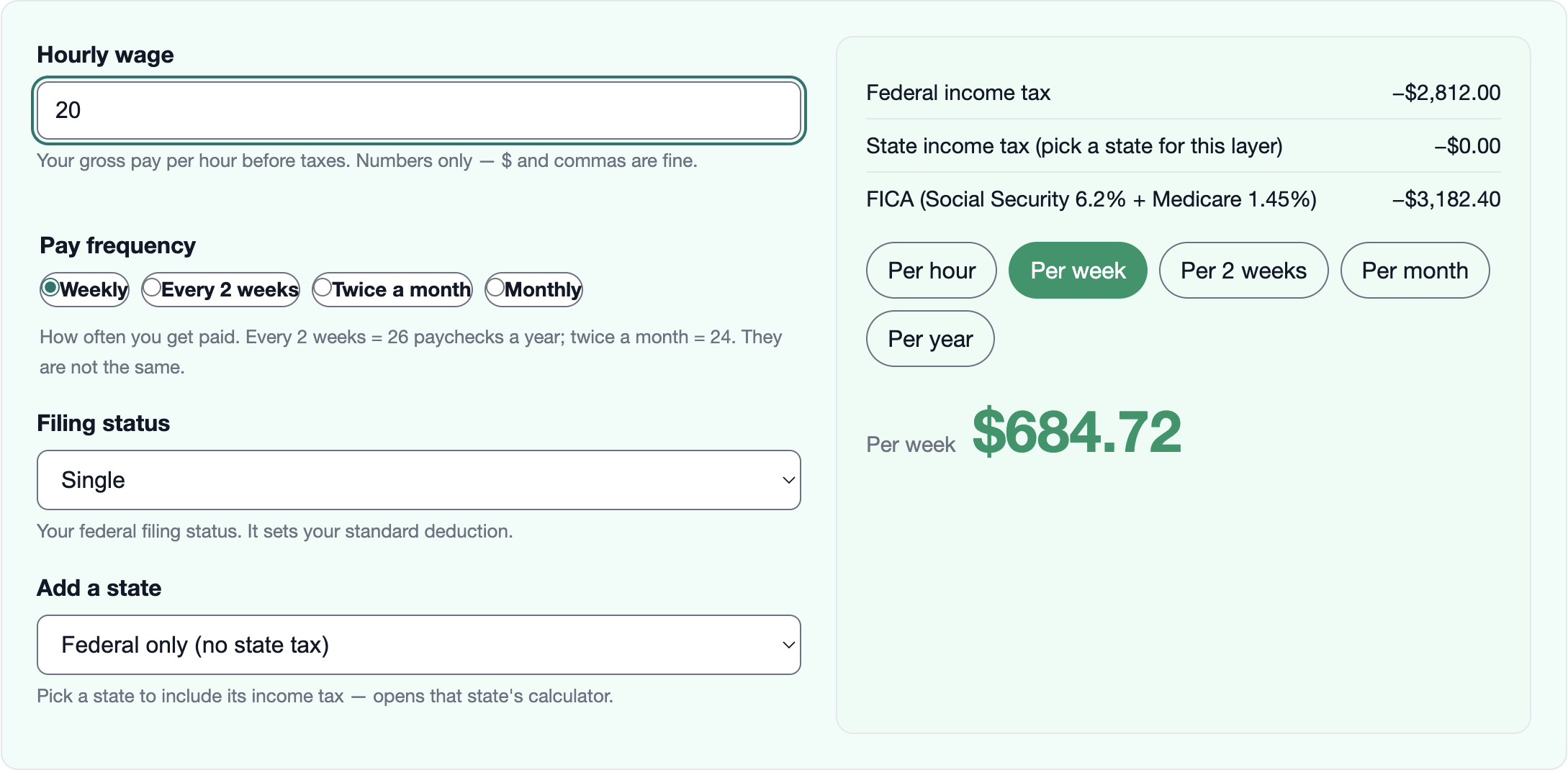
The state layer decides the rest. In states with no income tax — Texas and Florida, for two — the federal math is the whole story; try the Texas hourly paycheck calculator to see the weekly take-home on a $20 wage with zero state tax. The screenshot below shows the federal-only baseline this article's example starts from: $684.72 per week on $20 an hour, single filer, 2026 brackets.
Is it better to claim overtime on my taxes?
You never choose whether to report overtime — your employer reports W-2 wages, and unreported overtime income is tax evasion, not a strategy. The real question is whether you claim the new overtime deduction itself, and there the answer is unambiguous: if you have qualified FLSA overtime, you claim it, because the deduction only ever lowers your tax.
Practical notes for the claim: for tax year 2025, W-2s do not separately report qualified overtime, so keep pay stubs or a simple log of overtime hours as substantiation. File jointly if married — separate filers are locked out. And remember the sunset: unless Congress extends it, the deduction disappears after tax year 2028, so long-range planning should not count on it forever.
Frequently asked questions
How do I calculate my overtime pay per hour?
Multiply your regular rate by 1.5 — that is your overtime rate per hour. If you earn $20 an hour, overtime pays $30 an hour. Then multiply that rate by the number of overtime hours you worked in the week: 5 overtime hours × $30 = $150. For double time, use 2 × the regular rate instead.
What is double time for $20 an hour?
Double time for a $20 hourly wage is $40 an hour. It only applies where state law or your contract provides it — California past 12 hours in a day is the classic case — because federal law requires only time-and-a-half. There is no federal double-time mandate for ordinary workweeks.
How much tax will I pay on my overtime?
The same rates as your regular wages: your marginal federal income tax bracket plus 7.65% FICA. A $20 wage earner in a 12% bracket keeps roughly 80 cents of each overtime dollar before state tax. From 2025 through 2028, the OBBBA deduction can exclude the premium half of qualified overtime from income tax.
Is overtime tax-free?
No. The 'No Tax on Overtime' headline overstates a narrower benefit: a deduction for the FLSA premium portion (regular rate × 0.5 × overtime hours), capped at $12,500 a year ($25,000 joint), for tax years 2025–2028. FICA still applies to every overtime dollar, and the full 1.0× base pay was always taxable.
Is it better to claim overtime on taxes?
You cannot choose to skip reporting overtime — employers report W-2 wages. What you should claim is the overtime deduction itself if you have qualified FLSA overtime: it only lowers your tax. Keep pay stubs or hour logs for tax year 2025, when W-2s do not yet report it separately.
What's the tax rate on overtime pay?
There is no separate overtime tax rate. Overtime is taxed as ordinary income at your marginal bracket, plus 7.65% FICA on the full amount. A big overtime check is withheld at a higher effective rate because payroll annualizes one check, but the annual return reconciles it to your true bracket.
How is overtime hours taxed compared to salary wages?
Exactly the same way — the tax code does not distinguish them. Overtime dollars stack on top of your regular pay and are taxed at whatever marginal bracket they land in. The practical difference is withholding optics: lumpy overtime checks get over-withheld during the year and refunded after filing.
Do all states pay overtime the same way?
No. Federal law requires 1.5× past 40 hours a week everywhere, but California adds daily overtime past 8 hours and double time past 12, and Alaska, Colorado, and Nevada add daily triggers too. Where state law is more generous, it wins. Overtime premium pay itself is not taxed differently by state.
Does overtime count toward Social Security?
Yes. Every overtime dollar is subject to the 6.2% Social Security tax and 1.45% Medicare tax, and it also counts as earnings for your Social Security benefit record and Medicare surtax purposes. The 2025–2028 overtime deduction is an income-tax deduction only — it does not reduce FICA.
Can I use the overtime deduction if my employer pays double time?
Yes, but only the 0.5× FLSA premium portion qualifies, even when you are paid 2×. The deduction formula is regular rate × 0.5 × qualified overtime hours, and only hours past 40 in a week under federal FLSA rules count — state daily overtime, such as California's, is excluded from the deduction even though it is still fully legal overtime pay.